
Talent management · creators, not employees
Talent management for a roster of 3 to 30 creators.
Not HR software, and not a sales CRM. KitVerify gives every creator you represent one record — media kit, rate card, terms, audience — and the roster links you send brands are built from those same records.
Free to start. No credit card. Keep 3 talents live on the free plan.
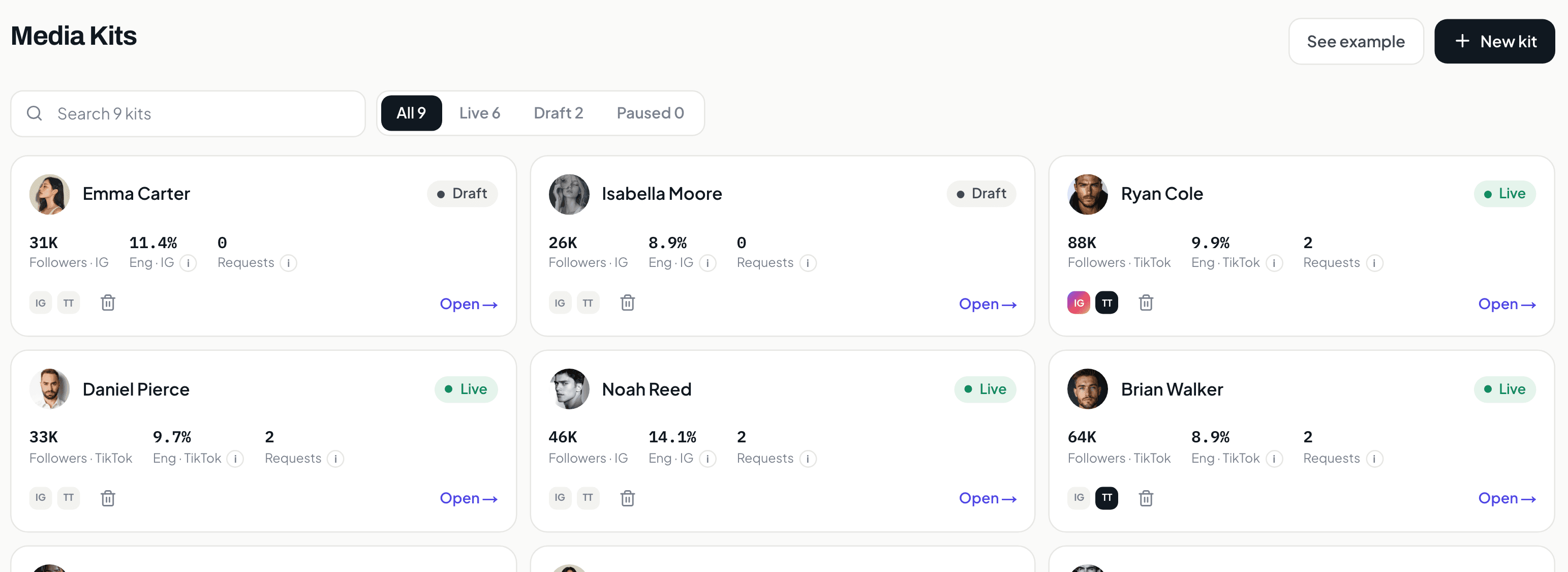
A real KitVerify workspace, seeded with sample creators. The numbers belong to that sample, not to a real roster.
Before and after
Talent management, when the talent are creators
Nothing built for HR fits this job, and neither does a sales CRM. What a creator manager actually holds is one record per creator — their audience, their best work, what they charge, and what they will not do — plus a way to put the right three of them in front of a brand this afternoon. Most managers hold that in a folder per creator and rebuild it by hand every time.
Before
- A folder per creator: a deck, a rate note, last month's screenshots
- HR and CRM tools that model employees or deals, never creators
- A rate card in a sheet that no longer matches the deck you sent
- Terms agreed in a DM and re-typed for every brand
With KitVerify
- One record per creator: profile, channels, audience, top content
- A rate card and a terms list attached to the creator, not to a file
- Campaign rosters assembled from those records and sent as one link
- Instagram and TikTok numbers that sync onto the record, labelled by source
What you get
What the workspace actually gives you
Three things a manager has on day one. Each is shipped behaviour, not a roadmap line.
01
One record per creator
Profile, channels, audience, top content, rate card and terms sit on the creator — not across a drive, a sheet and a chat thread. Open the record and you have the whole answer.
02
A roster you can pitch today
Pick the creators that fit a brief, publish a roster, and send one link — or a PDF when the brand wants a file. Every figure on it resolves from those creator records.
03
Edits that reach every link
Change a rate, a package or a top post once and the public kit, the next PDF, and every roster that creator sits on all read the change. There is no second copy to remember.
Inside the workspace
What "one record per creator" actually looks like
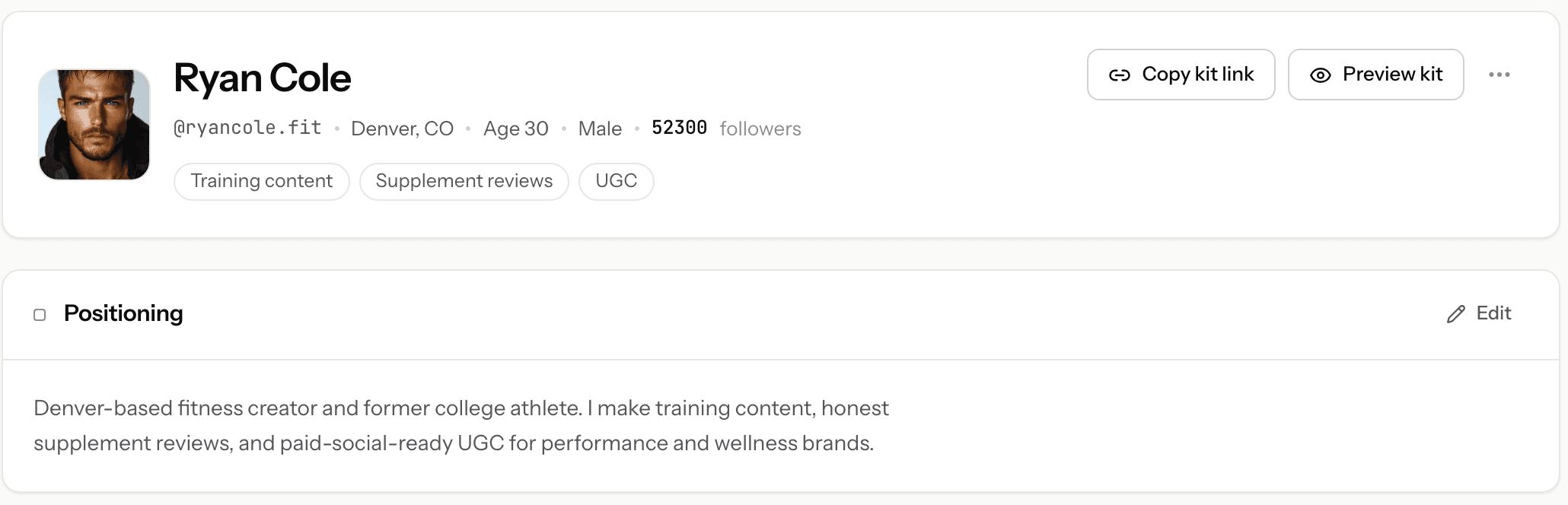
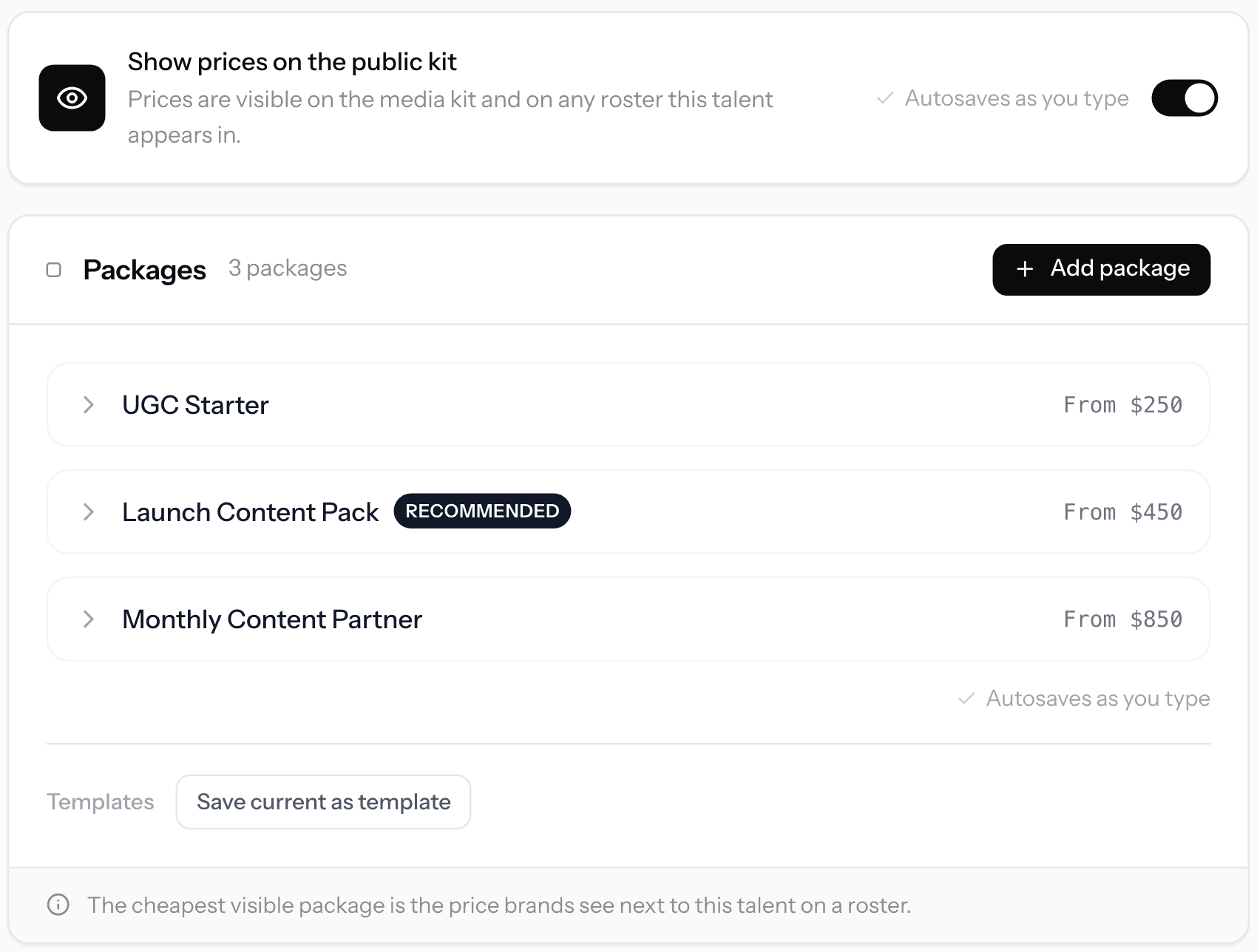
Three tabs of the same creator record in a real manager workspace: who they are, what they charge, and the ground rules that travel with them into every pitch.
01
The creator, not an employee file.
Handle, location, niche, positioning, and how close their kit is to ready — beside the actions that copy their public kit link or preview it. This is the page you open when a brand asks about someone, and it replaces the folder their deck and their rate note used to live in separately.
02
A rate card on the record, not in a sheet.
Packages and prices belong to the creator, with one switch deciding whether a brand sees the prices on the public kit at all. Change a price here and every roster that creator appears on reads the new one — there is no second place holding the old number.
03
Terms that travel with every pitch.
Usage rights, revisions and approval, payment: written once for the creator and shown on every kit and roster they appear on, so a brand sees the offer and the ground rules in the same place instead of discovering them after the yes.
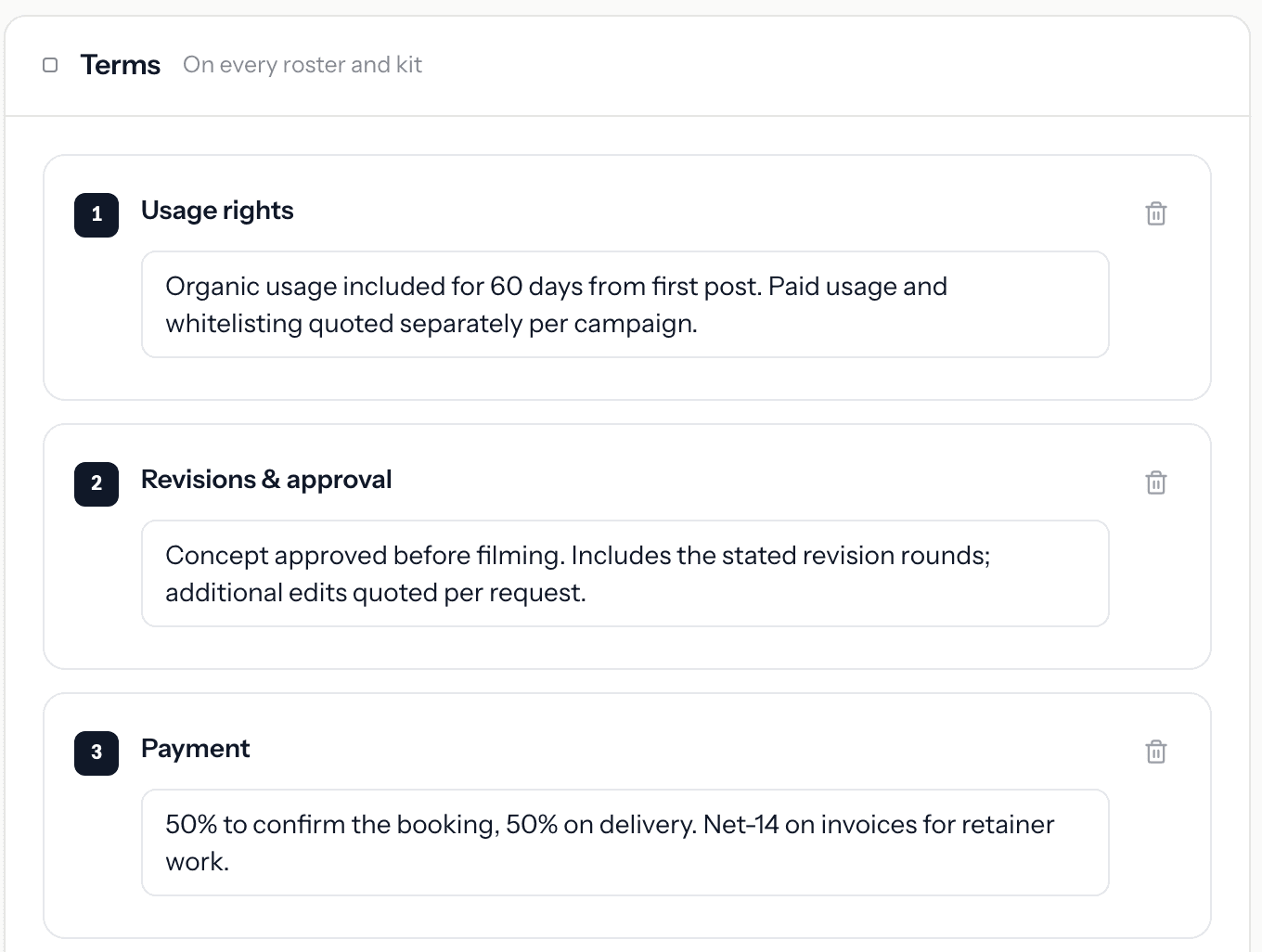
Screens from a KitVerify workspace seeded with sample creators. Numbers shown belong to that sample, not to a real roster.
How it works
How KitVerify works
Step 1
Create your manager workspace
Sign in with Google and you get a talent-manager workspace. Start adding the creators you represent — you can build a media kit before a creator has even signed up.
Step 2
Build each creator's kit, rates, and terms
Fill in audience, past work, packages, and rates for each creator. Send a delegated connect link so they attach their own Instagram or TikTok read-only, and supported metrics sync with a source label.
Step 3
Pitch with rosters and collect requests
Assemble a campaign roster for a brief, share it as a link or PDF, and let brands send structured collaboration requests that land in one inbox with a simple status.
What it does
What you run from the workspace
The creator side of a management business, and nothing that pretends to be an HR system or a sales CRM.
One workspace for every creator you represent
Keep each creator's media kit, rates, and audience in one place instead of a folder of PDFs. Build as many as you like — drafts are never capped — and the plan meters only how many stay published at once: 3 free, 10 on Solo, 30 on Studio.
Live media kits you update once
Every creator gets a public media kit at a shareable link — audience, performance, past work, and packages. Edit it once and the link is current; no re-exporting a deck for every brand request.
Rates, packages, and terms in one view
Set each creator's packages and rates, keep a rates overview across the roster, and show your standard terms alongside them — so a brand sees the offer and the ground rules together.
Brand-facing rosters and shortlists
Build a campaign roster — a shortlist of the right creators for a specific brief — and share it as a clean public link or a PDF. Pick who is on it, what each one costs, and what the brand sees.
One edit reaches every place the creator appears
Change a rate, a package, or a top post once on the creator's kit and the public link, the PDF export, and every campaign roster that creator sits on all read the same record. There is no second copy to remember.
Optional read-only social connection
Creators can connect Instagram or TikTok read-only so supported metrics sync from the official APIs with a source label. Delegated connect links let each creator link their own account — no shared passwords, no logins to manage.
Inbound collaboration requests in one place
Brands reach out through a structured request on each kit — company, campaign, budget, timeline — and requests land in one inbox with a simple status you move as the conversation progresses.
Honest scope
What KitVerify is not
Two whole software categories share the phrase "talent management". KitVerify is neither, and this is the short version so nobody finds out on day three.
- An HRIS. No hiring, onboarding, employee records, payroll, time off, performance reviews or org charts. The people on your roster are not your employees, and KitVerify holds nothing that treats them as such.
- A sales CRM. There are no brand contacts, deal stages, pipelines, reminders or forecasts. Inbound collaboration requests arrive in one list with a simple status you move — that is the whole of it.
- Outbound anything. No brand discovery, no email sequences, no inbox or Gmail sync, no auto-pitching. You send the link to the brands you already know.
- Contracts, e-signatures, invoicing, payment tracking or revenue accounting. A creator's terms state your ground rules on every pitch; they do not sign or bill anything.
- Campaign delivery or post-campaign reporting. KitVerify measures how a media kit or a roster link is performing, never how a delivered campaign performed.
Who it is for
Built for a roster of 3 to 30
Managers with 3 talents or so
Three or four creators, each of whom still has to look as finished as a big agency's talent. The free plan keeps 3 talents live for as long as you like while you build the rest as drafts.
Managers growing past a dozen
At fifteen or thirty creators the folder-per-creator method stops working entirely. One record each, one roster link per brand, and a ceiling that moves with the plan — 10 live on Solo, 30 on Studio — instead of a method that has to be replaced.
FAQ
Common questions
Is this HR talent management software?
No. KitVerify has nothing to do with hiring, employee records, payroll, time off, performance reviews or org charts. "Talent" here means the creators and influencers a manager represents, and the software manages their media kits, rate cards, terms, campaign rosters and inbound brand requests.
Is it a CRM?
No. There are no brand contacts, deal stages, pipelines, reminders or forecasts, and no outbound side at all — no sequences, no inbox sync, no brand discovery. Brands send a structured collaboration request from a creator's kit, those land in one list with a simple status you move, and that is the entire relationship-tracking surface. If you need a real pipeline, keep the CRM you have and use KitVerify for the creator side.
I represent 3 creators. I represent 30. Does it fit either way?
Both. The workspace is the same at either end; only the number of PUBLISHED kits is metered, and drafts are never capped. 3 talents stay live on the free plan, 10 on Solo, 30 on Studio. Past 30 creators you are outside the self-serve band and Scale is the plan to ask about.
What is actually on a creator record?
Their profile (handle, location, niche, positioning), their channels and the audience numbers behind them, their top content, their rate card of packages and prices, and their terms. From that one record you publish a public media kit at a shareable link, export a PDF, and add the creator to any campaign roster — all three read the same record rather than copying it.
Where do the numbers come from?
Creators connect Instagram or TikTok read-only — through a delegated link, so they sign in themselves and you never hold a password — and the metrics those official APIs expose sync onto the record with a source label and a last-synced time. Everything else is typed in and stays labelled self-reported. KitVerify never invents a number. The full mechanism, including how often it refreshes, is on the "How syncing works" page linked below.
What does KitVerify cost?
Free to start, with no card required and no trial to run out: the free plan keeps 3 talents and 1 campaign roster live for as long as you like, and drafts are never capped. Solo is US$29/month for 10 live talents, Studio is US$79/month for 30, and Scale is custom. Cancel anytime.
One record per creator. One link per brand.
Free to start, no card. Build a creator's record before they have signed up, and send a brand-ready roster link the same day.
Free to start. Solo US$29/month, Studio US$79/month. Cancel anytime.
Related
Keep exploring
How syncing works
Where the numbers come from, how often they refresh, and why a link you already sent stays current.
Talent management software
The purpose-built workspace for managers of creators.
Creator roster management
Move your roster off spreadsheets into one workspace.
Talent manager tools
How managers actually run a roster — spreadsheets to purpose-built.