UGC Creator Rates in 2027: What Talent Managers Should Charge Brands
Published 2026 data puts a typical UGC video near $175–$200, with experienced creators far above that. How to place a creator on that range, price every extra on its own line, and send a quote that adds up.
How a UGC quote is built
- Place the creator: beginner, mid-level or premium
- Set a price per video for that level
- Add hooks and raw files as their own lines
- Price paid usage by how long the brand runs the ads
- Discount the bundle, never the rights
A brand asks how much one of your creators charges for three UGC videos. The creator has 4,000 followers, so the usual follower formula says almost nothing. Then the brand adds that it wants to run the videos as ads for three months. Now the question is really two questions: what the videos cost, and what the rights cost.
UGC (user-generated content) is video or photo a creator makes for a brand to post on the brand's own channels, usually as ads. The brand is buying the asset, not the creator's audience. This guide shows the published rates for 2026, how to place a creator on them, how to price each extra, and a full quote you can copy.
What UGC creators charge: the published 2026 numbers
There is no official UGC price list, and the sources disagree. The table puts the main published figures side by side, with what each one actually measures. All were read on 4 November 2026.
| Source | What it measures | Figure |
|---|---|---|
| Collabstr 2026 report | Average cost of UGC campaigns on its marketplace, from 21,000+ collaborations | Under $197, down 5% on the year before |
| Influee | Price of a single UGC video, no method stated | Average $150–$212, median about $175 |
| Insense (Sep 2026) | Benchmark ranges per video, by creator level | Beginner $50–$400 · mid-level $150–$1,000 · premium $500–$3,000+ |
| ppc.io (Jan 2026) | List prices on six UGC marketplaces | From about $83 a video (Billo, 6 for $500) to $300 (UGC-Shop, 4 for $1,200) |
Two things explain the spread. Marketplace averages include many first-time creators on low list prices: Collabstr also reports that nearly 80% of all its collaborations are priced under $300. And the top of the range is set by creators whose videos have already run as ads that sold, which no average captures.
How to place a creator on the range
The question a manager actually faces is not "what do UGC creators charge" but "where does this creator sit". Three levels cover most rosters. The ranges are Insense's; the signs that place a creator are the ones a brand will check when it opens the portfolio.
| Level | Signs a brand will look for | Per video |
|---|---|---|
| Beginner | Portfolio of spec work or a few small brands; simple talking-head or product shots | $50–$400 |
| Mid-level | Paid work for several brands; scripts their own hooks; clean edits with captions | $150–$1,000 |
| Premium | Ads that ran at scale; brands come back; can show results such as a winning ad or a repeat client | $500–$3,000+ |
Within a level, the price moves with production. A single phone video with one hook is the bottom of the range. Scripting, several locations, props, voice-over and on-screen text move it up. The rate calculator uses $300 a video and $175 a photo set as its mid-level anchor, quoted as a band of $225–$375. That sits above the marketplace averages on purpose: it prices a creator with paid work behind them, not a first listing.
What a base UGC rate includes
Most disputes on UGC deals start with a base rate that never said what it covered. Write it on the rate card and in every quote. A clean base rate includes:
- One finished video, edited, at an agreed length (for example up to 30 or 60 seconds) and aspect ratio.
- One hook, meaning the opening two or three seconds. Extra hooks are priced separately.
- One round of revisions on the edit, not a reshoot.
- Organic use: the brand may post the video on its own channels. Running it as a paid ad is extra.
- The final file only. Raw clips stay with the creator unless the brand buys them.
Everything outside that list is a line item. A brand that wants less can drop a line instead of asking for a lower price on the whole deal.
How to price the extras on a UGC deal
For UGC, the extras are often worth more than the video. The table lists the common ones, with the published ranges for each.
| Extra | What the brand gets | Published price |
|---|---|---|
| Extra hooks | Different openings on the same video, to test in ads | $50 each (Influee) |
| Raw footage | The unedited clips, so its own editors can cut new versions | 30–50% of the base rate (Influee) |
| Paid usage | Runs the video as an ad from its own account for a set time | 30–50% of the base rate (Influee, ppc.io) |
| Whitelisting / Spark Ads | Runs the ad from the creator's own account | 30% per month (Influee); 30–100% per month (ppc.io) |
| Rush delivery | Gets the files faster than the normal turnaround | 25–50% (Influee) |
| Bundle | Several videos in one brief | 5–10% off for 2, 10–15% for 3–4, 15–25% for 5+ (Influee) |
Whitelisting means the brand runs the ad through the creator's account, so it shows the creator's name and photo. On TikTok this is called Spark Ads; on Instagram and Facebook, Partnership Ads. It is priced per month because the creator's identity is in the ad for as long as it runs.
Price usage by time, and say the end date
Paid usage is the line most often given away. "Usage included" with no end date means the brand can run the video for years. Price it by window, for example 30, 90 days or 12 months, and write the end date in the quote. A permanent buyout is the most expensive line on the card, so quote it only when asked.
Discount the videos, never the rights
If you give a bundle discount, take it off the videos only. Work out the usage price from the full video price before the discount. Otherwise a 15% bundle quietly makes 90 days of ads 15% cheaper too.
A worked UGC quote, line by line
Here is an illustrative brief, invented for this example: a skincare brand wants 3 videos from a mid-level creator, two extra hooks on each, the raw files, and 90 days of paid usage. The creator gives 10% off for three videos. The totals come from KitVerify's quote builder arithmetic: usage is priced on the subtotal before the discount.
| Line | Quantity | Price | Amount |
|---|---|---|---|
| UGC video | 3 | $300 | $900 |
| Extra hook | 6 | $50 | $300 |
| Raw footage | 3 | $90 | $270 |
| Subtotal | $1,470 | ||
| Bundle discount (10%) | −$147 | ||
| Content fee | $1,323 | ||
| Usage rights · 90 days (50% of subtotal) | $735 | ||
| Total to the brand | $2,058 |
Notice where the money is. The three videos are $900; the hooks, raw files and usage add $1,305 more before the discount comes off. A manager who quoted "three videos, $900" and agreed to the rest by email would have given away more than half the deal.
If the creator has a minimum, check it against the content fee, not the total. A minimum is the lowest price for the work. Usage is a separate thing the brand is buying, and it should not hide a content fee that is too low.
Your commission: from the fee or on top of it
Decide before you quote whether your commission comes out of the total or sits on top of the creator's price. Using an illustrative 20% on the quote above:
| Method | Brand pays | Creator receives | Manager receives |
|---|---|---|---|
| Commission from the fee | $2,058 | $1,646.40 | $411.60 |
| Creator's price is net; quote grossed up | $2,572.50 | $2,058 | $514.50 |
Either works if it matches the management agreement. What causes trouble is mixing them: a creator who quotes their own net rate to a brand, while the manager quotes the same brand a grossed-up one. Pick one method for the whole roster.
Should UGC rates go on a media kit?
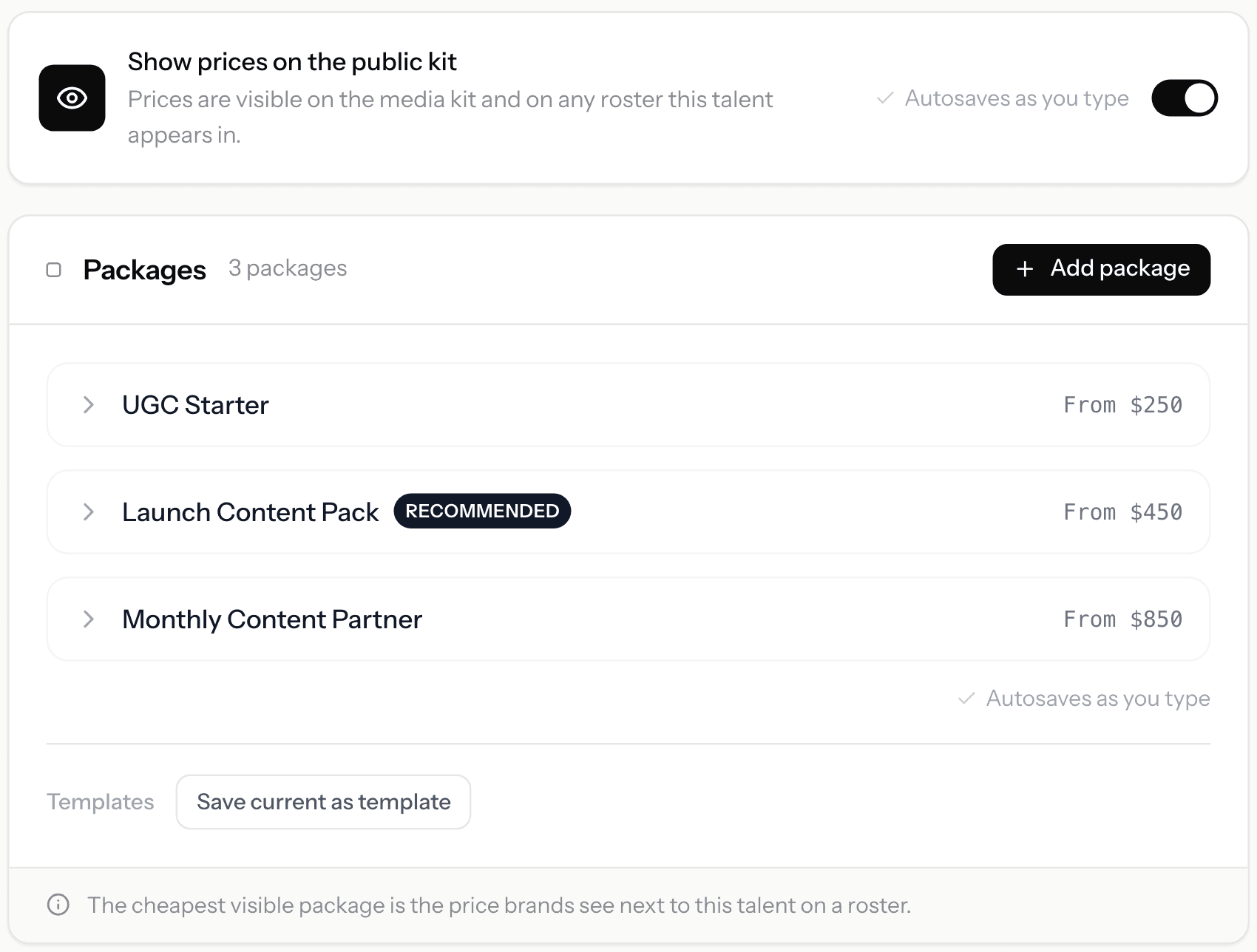
A UGC creator's media kit is mostly a portfolio: the videos, the brands, and any results. Prices are optional. A From price per video filters out briefs that cannot reach it, and it is useful for creators who get many small inbound requests. For anything with usage, whitelisting or several videos, send a quote instead, because those lines change the total more than the video price does.
Never publish the minimum, and never publish usage percentages. The filled influencer rate card example shows the same public-versus-private rule for sponsored posts.
Pricing UGC across a roster
A manager with several UGC creators should keep the extras the same for everyone: the same hook price, the same usage windows and percentages, the same bundle steps. Only the base video price changes by creator. A brand comparing two of your creators then compares one number, and a quote for one creator can be rebuilt for another in a minute.
When a brand asks for options, send the shortlist as one link with each creator's portfolio and base price, or without prices if you would rather quote. The guide to building a creator roster for brands covers what goes on it, and the roster generator builds one from a list of handles.
Where KitVerify fits
The influencer rate calculator prices UGC per asset, never per follower. Set how many videos or photo sets, add raw footage or rush, and it shows the band and the arithmetic. No account needed.
On manager plans, each creator's packages and private minimums live on their Rate Card, and a quote is built on one screen with the same order as the example above: videos, discount, then usage priced on the full subtotal. The brand gets a link showing amounts only, never your percentages, and the quote warns you if the content fee falls under the creator's minimum.
Related questions
How much do UGC creators charge per video in 2027?
As of November 2026, published averages sit around $175–$200 a video: Collabstr reports an average UGC campaign cost under $197, and Influee a median near $175. Beginners often charge $50–$400 and premium creators $500–$3,000 or more, by Insense's 2026 ranges.
How much should I charge for UGC usage rights?
Published guides put paid usage at about 30–50% of the base rate, priced by how long the brand runs the ads. Always write an end date. A permanent buyout should cost much more than a 90-day window.
What is the difference between usage rights and whitelisting?
With usage rights, the brand runs the video as an ad from its own account. With whitelisting, it runs the ad from the creator's account, under the creator's name: Spark Ads on TikTok, Partnership Ads on Instagram and Facebook. Whitelisting is usually priced per month on top of the video.
Should UGC be priced by follower count?
No. The video runs on the brand's channels, so the creator's followers do not see it. Price UGC by the creator's level, the production involved and the rights the brand buys.
How much should a beginner UGC creator charge?
Insense's 2026 range for beginners is $50–$400 a video, and marketplace list prices for new creators often sit near $100. A beginner with a strong portfolio of spec work can price at the top of that range, and should still charge separately for usage.
What should a base UGC rate include?
One finished video at an agreed length, one hook, one round of revisions and organic use on the brand's channels. Paid usage, extra hooks, raw footage and rush delivery are separate lines.
How do talent managers take commission on UGC deals?
Either out of the total the brand pays, or on top of a creator's net price by grossing the quote up. Both work if they match the management agreement. Use one method across the whole roster so creators and brands never see two different prices.
Sources
- Hello Partner on the Collabstr 2026 Influencer Marketing Report (13 Jan 2026), average UGC cost under $197, down 5%; UGC at 35% of collaborations · read 4 Nov 2026
- Storyboard18 on the same report (20 Mar 2026), 21,000+ collaborations; nearly 80% priced under $300 · read 4 Nov 2026
- Influee, UGC rates guide, average and median per video, add-on and bundle prices; no method stated · read 4 Nov 2026
- Insense, UGC creator rates (14 Sep 2026), per-video ranges by creator level · read 4 Nov 2026
- ppc.io, UGC pricing on six marketplaces (12 Jan 2026), marketplace list prices, usage and whitelisting ranges · read 4 Nov 2026
KitVerify
Price a UGC brief in a minute.
Enter how many videos or photo sets, add raw footage or rush, and the calculator shows the band and the arithmetic. UGC is priced per asset, never per follower.
About the author
Dennis Tjahyadi · Founder, KitVerify
KitVerify is being built around the workflows of talent managers and creator agencies. This blog documents what we are learning about how those teams organize, maintain and pitch their talent — from product research, conversations with managers, and observing real workflows, not from having managed talent ourselves.
How KitVerify sources and labels every number it shows: methodology.
Related reading
- Rates & MetricsInfluencer Rate Card: What Goes on It, With a Filled ExampleA rate card lists what you charge per deliverable and what costs extra. Here is a filled one, how each line is priced, and the rule for which prices brands see and which stay private.
- RostersHow to Create a Creator Roster That You Can Send to BrandsWhat belongs on a brand-facing roster and what stays on each creator's page, how many creators to send, when to show rates, which format to use, and a card template and roster structure you can copy.
- Media KitsHow Talent Managers Can Manage Media Kits for Multiple CreatorsThe operational problem behind stale media kits is copies, not effort. This guide shows the fragmented architecture most managers run, the single-source alternative, and a routine for keeping every kit current.
- RostersHow to Manage an Influencer Roster Without a Mess of SpreadsheetsWhat a roster actually has to hold per creator, a sample structure you can copy, an honest comparison of spreadsheet, Drive/Notion and purpose-built workflows, and when to move off the sheet.